

How to Delegate Agency Operations Without Losing Control
Set decision boundaries, escalation rules and a reporting rhythm so delegated agency work stays visible without constant checking.
Delegating agency operations becomes easier when control is written into the process: a named owner, clear permissions, a visible task record and an escalation route. This guide is about decision ownership and visibility. For checking deliverable quality, use the separate quality-control guide.
Define the responsibility, not just the activity
“Follow up with clients” is an activity. “Keep the weekly approval queue current, send approved reminders and flag overdue decisions” describes a responsibility. State the input, expected output and place where progress is recorded so the owner can tell whether the process is working.
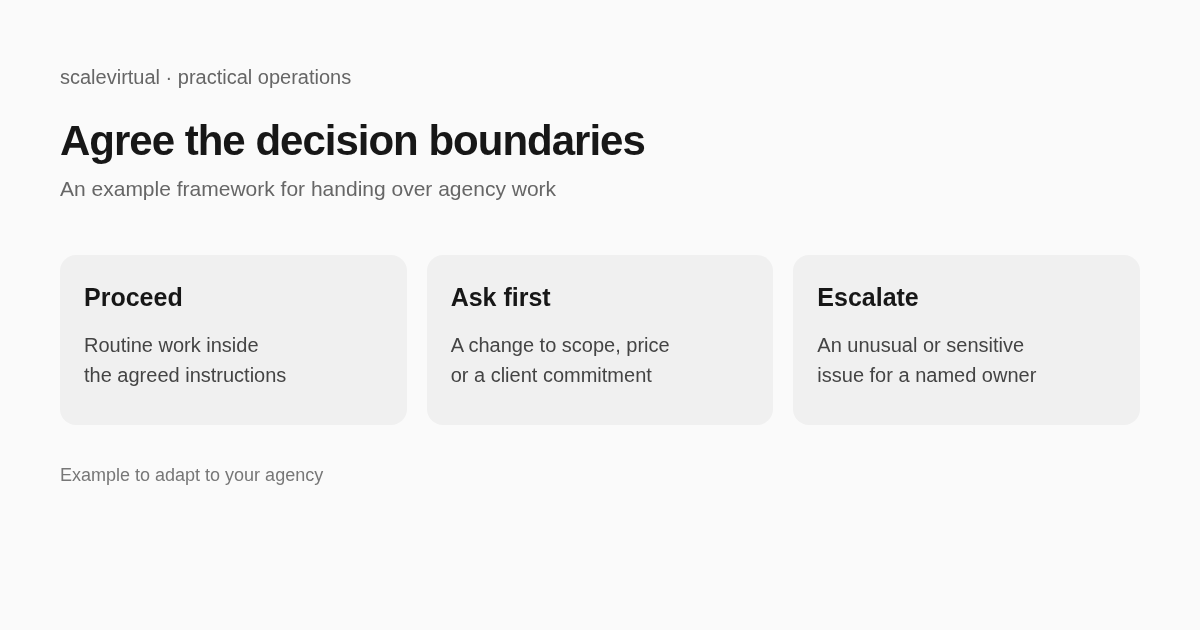
Use three decision boundaries
- Proceed: routine work covered by the instructions, such as scheduling within approved availability.
- Ask first: a request that changes a deadline, price, scope or other commitment.
- Escalate: a sensitive or unusual issue that needs a named decision-maker.
Those categories are an example, not a substitute for your agency’s own approval rules. Record the actual thresholds and approvers in the handover.
Make exceptions visible
Create a place to record the issue, its effect, the decision needed and the person responsible. A message saying “blocked” is less useful than “waiting for the client’s final assets; Friday’s review depends on receiving them by the agreed date; account lead to follow up.”
Agree a reporting rhythm
Use one source-of-truth board and a short review at the frequency the work needs. The report should connect completed work, upcoming dates and decisions. Download the weekly operations report template and remove fields that do not help your decisions.
Change the rule when the same question repeats
If the owner repeatedly asks the same question, inspect the SOP before deciding they need more supervision. The instruction may be missing a condition or an example. Add the answer to the process and test it on the next task.
Start with a bounded handover
Choose a recurring process with a clear output, such as inbox triage or scheduling. Use the handover checklist to agree permissions and escalation. If you want that process managed for you, explore inbox and calendar support.
Explore inbox & calendar management support.
Want this handled for your agency instead of reading about it?