

How to Build Standard Operating Procedures Your Team Will Follow
Write a practical agency SOP with a trigger, inputs, steps, decision rules and completion checks, then test it with someone new to the task.
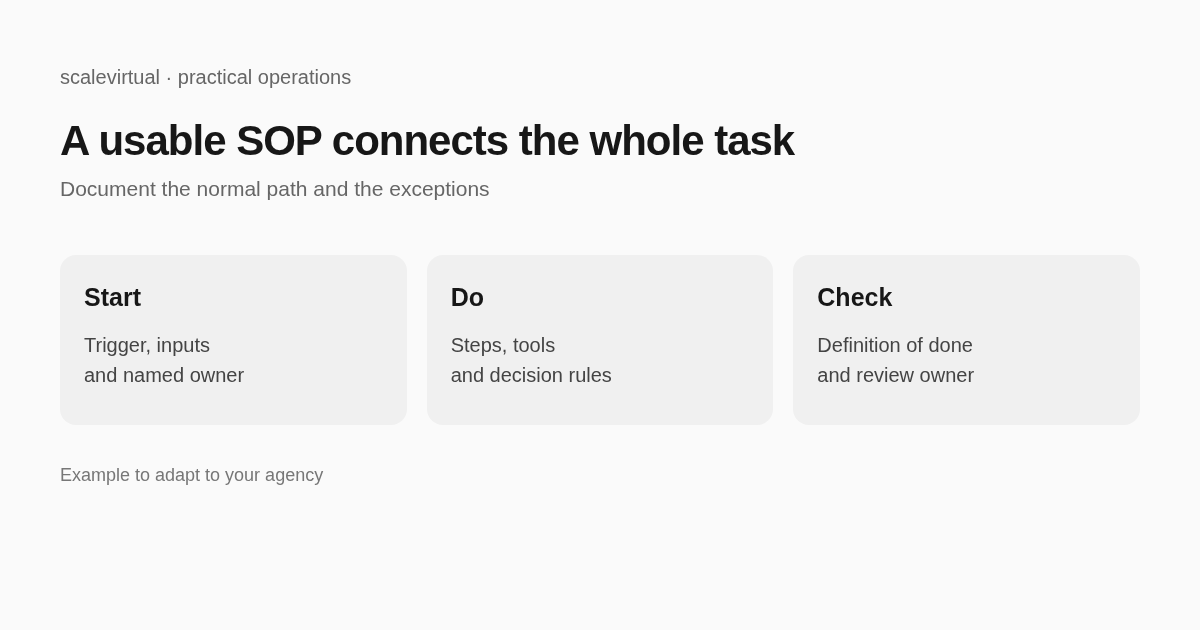
A useful standard operating procedure explains how to complete a recurring task without relying on the author’s memory. It names the trigger, required inputs, owner, steps, exceptions and definition of done. Start with a real task, then test whether another person can follow the instructions.
Choose a narrow process
“Run client delivery” is too broad for one task instruction. “Prepare the weekly client update from the project board” gives the SOP a clear beginning and end. A broader delivery system can link several SOPs together without turning each one into an operating manual.
Capture the work as it happens
Follow a representative task and record the actual steps, tools and checks. Note where the owner makes a decision. Avoid documenting an imaginary ideal process that differs from the work your team must complete tomorrow.
Use a consistent SOP structure
- Purpose and trigger.
- Required inputs and approved access.
- Named owner and reviewer.
- Steps with expected outputs.
- Exceptions, approvals and escalation.
- Definition of done and next review date.
The agency SOP template provides those fields in an editable text file.
Example: preparing a client update
An illustrative SOP could start when the weekly reporting window opens. The owner checks the source board, lists completed work and the next milestones, flags missing inputs, and drafts the update. A new deadline or commercial commitment goes for approval before sending. The completion check is that the message matches the board and any new tasks are recorded.
This is an example workflow, not a client case study or a claim that every engagement uses the same schedule.
Test the instructions with someone new
Ask a person unfamiliar with the process to use a safe sample task. Record each place they need an explanation, cannot find an input or interpret a rule differently. Improve the SOP rather than relying on a separate conversation to fill the gaps.
Give maintenance an owner
An SOP needs a person responsible for changes. Review it when the tool, input, approval rule or output changes. Archive superseded instructions so the team can identify the current version. If a stable repetitive step is suitable for automation, keep its human owner and exception route documented.
For help maintaining the process, explore workflow automation and SOP support.
Explore workflow automation & sops support.
Want this handled for your agency instead of reading about it?